
Spring is a season of renewal in the orchards, and for many crops, that means it’s time for pollination. Bees are often seen buzzing from flower to flower, playing a vital role in pollinating fruits, vegetables, and nuts. At Nichols Farms, bees play a vital role in the pollination process for our almond varieties. Unlike some newer varieties in the industry, such as the self-pollinating Independence, our traditional almond varieties depend entirely on bees for successful pollination. When bees visit almond blossoms, they transfer pollen between flowers, enabling fertilization and the development of nuts. This relationship between bees and almond trees has existed for centuries, making honeybees an irreplaceable partner in almond production.
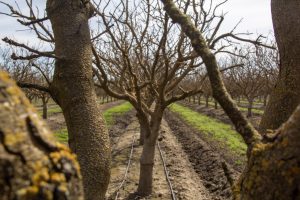
In contrast to our almond orchards, bees do not play a role in the pollination process for our pistachio trees. Instead, they rely on wind pollination. This means the wind carries pollen from male to female trees. Pistachios are dioecious, meaning there are separate male and female trees. The male trees produce pollen, and the wind then carries this pollen from male trees to female trees.
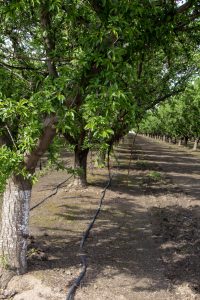 Pistachio flowers are small with no nectar or strong scents to attract bees. Instead, they produce large amounts of lightweight pollen designed to be carried by wind over considerable distances. This natural process is known as anemophily or wind pollination. At Nichols Farms, we strategically design our pistachio orchards to maximize effective wind pollination. Male trees are planted among female trees in a specific ratio ensuring optimal pollen distribution.

Despite the natural efficiency of wind pollination, we face specific challenges in our pistachio orchards. Weather patterns and temperature fluctuations can contribute to inconsistencies in the pollination process. These environmental factors can cause male and female bloom synchronization to be inconsistent, affecting crop production. It is very important for us to choose the correct female and male varieties for our specific geographical location to minimize these challenges. Different varieties have different bloom times and adaptation to local climate conditions, which must be carefully matched for successful pollination.
Although bees aren’t necessary for pistachio pollination, they remain valuable residents in our orchards. They contribute to the overall ecosystem health by supporting biodiversity and ecological balance, pollinating cover crops and wildflowers that grow in and around the orchards and helping with natural pest control by supporting beneficial insect populations.
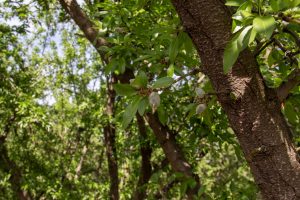
The agricultural industry, particularly crops that depend on bee pollination like our almonds, faces a significant threat from colony collapse disorder (CCD). This phenomenon has been causing honeybee populations to decline at alarming rates in recent years. (The Business Journal)
For almond growers, this is particularly concerning. California’s almond industry, which includes our operations at Nichols Farms, requires about two hives per acre for optimal pollination. With approximately 1.3 million bearing acres of almonds in California, the demand for honeybee colonies is enormous during the bloom period.
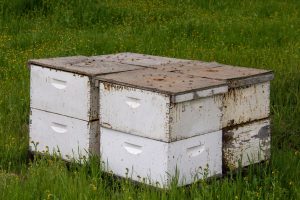
Understanding the delicate balance between agriculture and nature, Nichols Farms is committed to sustainable practices that support both our production goals and the environment. Whether it’s protecting the bees that are essential for our almond orchards or creating healthy ecosystems around our wind pollinated pistachio trees, we recognize that sustainable farming is the path forward.
The Business Journal. (2024, March 6). No bees, no nuts: How colony collapse disorder is threatening agriculture. The Business Journal. https://thebusinessjournal.com/no-bees-no-nuts-how-colony-collapse-disorder-is-threatening-agriculture/